
Who would have thought that my sweaty palms could ever be relevant for a study … I am Anna, a working student at Fraunhofer IIS, and that’s what I’m thinking to myself as I’m sitting wired up on...

Who would have thought that my sweaty palms could ever be relevant for a study … I am Anna, a working student at Fraunhofer IIS, and that’s what I’m thinking to myself as I’m sitting wired up on...

Robots and artificial intelligences are only as good as we train them to be. So why not train them to adept to us, their human counterparts? That’s the vision of affective computing: Incorporating emotional intelligence...

We have contributed two article’s to this year’s Trillium Pathology issue. Here are the abstracts, with links to the full articles: V. Bruns, Programming-free Image-Analysis Workflows for IHC, IF and Spatial...

This app note describes the MIKAIA Plugin API. It can be used by bioinformaticians to plug in their own AI script, e.g., written in Python or any other language, into MIKAIA® and this way put their AI into the hands of...

MIKAIA® is specifically designed for researchers in academia, CROs, biotech, pharma. One of the challenges is that researchers by design do unique things. For this reason, MIKAIA® apps do not represent individual side...

When acquiring data for affective computing, we aim for a multimodal mix of data as it allows for a more comprehensive and accurate understanding of human emotions and behaviors. By collecting multimodal data, such as...
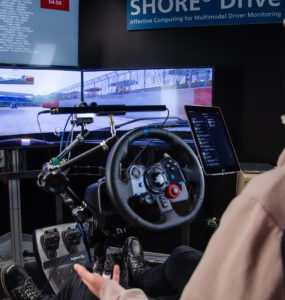
Not only does the future of mobility look autonomous: the present already is. Features like adaptive cruise control and lane centering support drivers and reduce required interactions with the vehicle, thereby...
AI is on the rise in pretty much every scientific field (at least it feels that way). We talked to Nathalie Falk, one of the voices behind the MIKAIA University application notes, molecular biologist with a PhD in...

Affective computing, also known as Emotion AI, is an area of artificial intelligence that focuses on developing systems and technologies capable of recognizing, interpreting, and responding to human emotions (read more...
The rise of powerful, data-driven machine learning methods...

© Fraunhofer IIS · 2026
 Anna Chiwona
 Grit Nickel
 Volker Bruns
 Ute Schmid
 Emanuel Slany
 Stephan Scheele