
 Nadine Lang-Richter
 Anna Chiwona
For many, wearables such as smartwatches or smart rings have become an integral part of everyday life. Particularly in sports and fitness, consumer wearables play a crucial role in tracking health data and individual performance. This growing popularity has led to an influx of new products, many of which claim to feature innovative algorithms.
However, can these devices live up to their claims? In a meta-analysis, Doherty et. al (2024) examined the accuracy of consumer wearables in measuring biosignals such as heart rate, energy expenditure, step counts, and sleep. They found that just 3.5% of consumer wearables were comprehensively validated for the various biometrics they measure. Approximately 11% of the commercially available wearables had been validated for at least one biometric outcome. Therefore, there is a clear need for the validation of wearables and a deeper examination of buzzwords like “fitness level” or “load index.”
Wearables
Wearable devices with built-in sensors simplify tracking health and fitness metrics. They gather, monitor, store, and visualize physiological and environmental data. To share and process this information, these devices use wireless body networks and algorithms to reduce motion artifacts while analyzing raw sensor data.
Wearables are attached to various body parts and chosen based on their specific functions. The attachment location also depends on the type of sensor used, such as bioelectric, optical, or inertial sensors. The greatest advantage of wearable devices lies in their ease of use and versatility, which make them highly convenient for a wide range of applications, from personal fitness tracking to clinical trials and remote patient monitoring, ultimately enhancing data collection and patient engagement.

We like to move it, move it: Wearables in professional sports
In addition to their applications in lifestyle and wellness, the use of wearables has surged in professional sports, where performance metrics and health are crucial. Monitoring training load serves several key purposes:
- Assessing an athlete’s adaptation to their training program.
- Evaluating individual responses to training.
- Identifying the onset of fatigue and recovery needs to reduce the risk of overload, injury, and illness.
- Optimizing professional training by tailoring approaches to meet the specific needs and responses of each athlete.
For this purpose and in the context of professional sports, the accuracy of wearables devices is essential. These devices must be unobtrusive during training and games to avoid any interference, thus saving space, energy, and weight. However, this need for compactness often limits the sensor data sets, restricting the amount and variety of data collected to preserve battery life. Consequently, this can lead to less accurate measurements.
In professional sports, however, wearables must deliver high accuracy and undergo rigorous validation for use in this environment. Additionally, features such as safety and user-friendliness need to be validated carefully and separately.
How accurate is accurate? Wearable validation at Fraunhofer IIS
As an independent research institute with long-term experience in sensor development and biosignal analysis, we conduct subject studies and automated tests. Our process includes the following steps:
- Implementation: Test subjects perform typical sports movements while data is collected using both wearables and the corresponding gold standard methods.
- Data Comparison: Test subjects perform typical sports movements while data is collected using both wearables and the corresponding gold standard methods.
- Validation: Based on this analysis, we calculate the respective metrics provided by the manufacturer, compare them with current research, and validate the results.
The specific wearables to be tested and the individual requirements are flexible and tailored to each customer’s needs. Depending on the study, the following components can be part of the measurements:
- Heart rate and heart rate variability
- Respiratory quotient: volume, frequency, and minute volume, aerobic threshold
- Ventilatory and anaerobic thresholds (caloric consumption)
- Electrodermal activity (EDA)
- Muscle activity with electromyography (EMG)
- Position and movement parameters (e.g., speed, acceleration)
- Event detection for specific movements (e.g., jumping, court transition)
- Gait-specific analysis (e.g., cadence, step width, foot angle, ground reaction force)
Since wearables are portable, we can conduct measurements anywhere. However, we typically stay on-site and use our multifunctional sports lab, where a range of equipment and reference systems are available. These include ECG, cardiopulmonary exercise testing, large-volume MoCap, and 3D laser tracking.

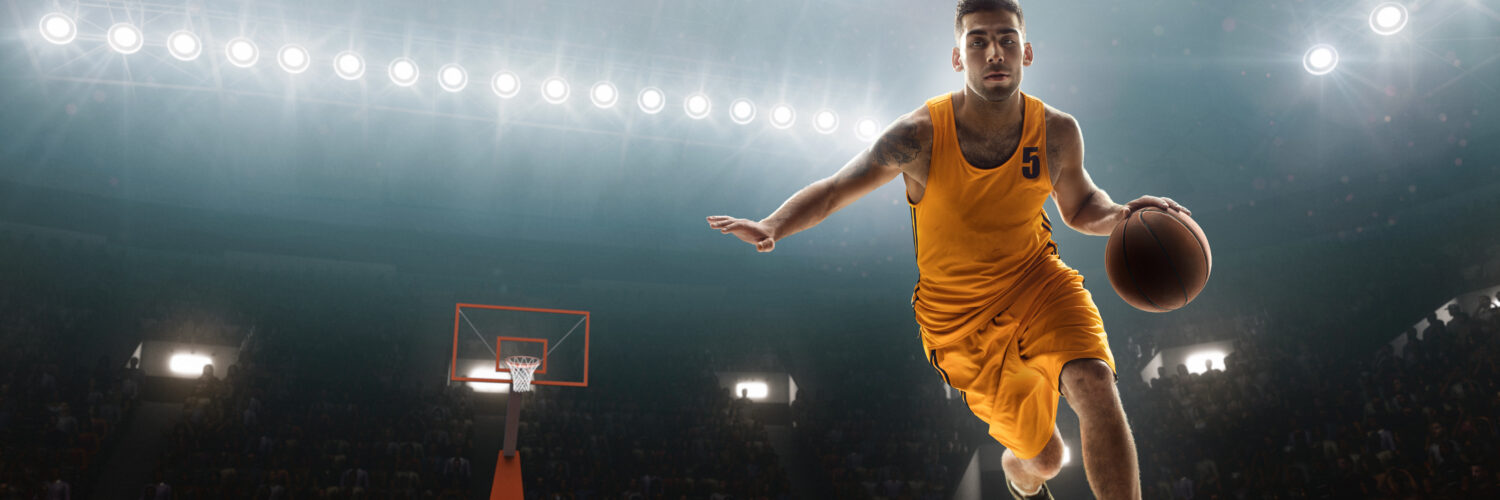
Accuracy in making shots, accuracy in biosignals: Wearable validation in professional basketball
Since 2018, we have partnered with the National Basketball Association (NBA), the National Basketball Players Association (NBPA), and the University of Michigan, to validate the devices that may be approved for voluntary use by NBA players during training. The goal of such validation testing is to independently assess the safety and accuracy of devices used for training and game preparation (learn more). The measurements are conducted at the L.I.N.K. test and application center of Fraunhofer IIS in Nuremberg.
After completing each study cycle, we provide the NBA and the NBPA with a detailed analysis of each device and metric tested, categorizing them as either pass or fail. These valuable insights assist both associations in selecting the most suitable wearables for players’ training and game preparation.
Basketball is not the only game we play
Not a fan of shooting hoops? Basketball is just one of many sports where wearables enhance health and performance, and their benefits extend into various non-sport sectors as well. As an independent research institute with years of experience in wearable validation and data analysis, along with esteemed partners like the University of Michigan, we offer a diverse range of services for both athletic and non-athletic applications.
Image Copyright: TandemBranding – stock.adobe.com & TandemBranding – stock.adobe.com/Fraunhofer IIS


 Grit Nickel
 Markus Jechow


Add comment