

 Grit Nickel
 Anna Chiwona
Wearables for Parkinson’s patients, a textile-integrated ECG for continuous monitoring, and contactless driver state recognition – just to name a few innovative solutions that have only been made possible through thorough studies and the right research infrastructure. As an application-oriented research institute, we are very fortunate to have a variety of laboratories and tools designed to meet diverse needs, customized for each study and unique product developments.
Multimodal data acquisition: Measuring psycho-physiological reactions
What makes our institute’s infrastructure stand out is not just the range of modalities and signals we can measure, but also the flexibility to do so in different, adaptable settings, depending on the specific application and research goals.
Psychophysiology Lab
Our psycho-physiological lab is designed for the acquisition of high-quality multimodal data. Central to our lab is the exposure cabin, which provides a controlled environment for synchronized data collection, unaffected by environmental influences. All equipment in the lab is designed to integrate specific measurement modalities, allowing us to tailor each setup to the unique requirements of every study.

Exposure Cabin
- 360° analysis of psycho-physiological reactions in a controlled environment with, e.g., defined light and noise environment
- Multimodal data acquisition and easy data synchronization
- Flexible modality setup, unaffected by environmental influences, including wearables and extensive sensor and camera equipment
- Individual adaptation of the experimental setup,
e.g., selection of modalities
Furthermore, our psychophysiological laboratory is equipped with the following resources:
- Video Monitoring System: Captures behavioral indicators and affective states for comprehensive analysis.
- BIOPAC System: Measures ECG, respiration, oximetry, EEG, EMG, and skin temperature for detailed physiological monitoring.
- AntNeuro EEG: Offers high-resolution brain activity monitoring for in-depth neurological assessments.
- Tobii Eye Tracker: Captures information about the eyes, such as gaze, pupil size and saccades, to infer cognitive and emotional states.
Driving simulator
Driving simulators enable easy and fast data collection during driving tasks and traffic scenarios. What sets our driving simulators apart is their compatibility with any technologies used in our exposure cabin, making them ideal for multimodal biosignal acquisition and gathering insights on driving behavior, driver states, well-being, and cognitive load (stress).
The driving simulators on-premise and at the Center for Sensor Technology and Digital Medicine at Universitätsklinikum Erlangen offer customizable modality setup of the driving simulator.

Advanced Sports Performance and Biomechanics Lab
The Sports Performance and Biomechanics Lab specializes in comprehensive assessments of athletic performances and physical activity. Our state-of-the-art equipment allows for flexible setups and advanced monitoring technologies to gather detailed physiological and biomechanical data:
- Gym Setup: Fully equipped facilities for diverse sports and exercise testing
- Ergometer and Track: Standard equipment for controlled cardiovascular and endurance assessments.
- BIOPAC System: Monitors ECG, respiration, oximetry, EEG, EMG, and skin temperature for thorough physiological analysis.
- Wireless BIOPAC System: Offers mobile monitoring capabilities, ideal for field and in-lab scenarios.
- XSens Cameras and Systems: Advanced biomechanical sensing using MVN Link, MVN Awinda 2, and pressure mapping for comprehensive motion capture and analysis..
- Mobile ECG (Holter): Includes BTL Flexi 12, BTL Holter 08, and CardioSecure for continuous heart monitoring.
- Smart Textiles: Integrates ECG and respiration monitoring directly into sportswear for seamless data collection.

CardioTEXTIL
CardioTEXTIL is a mobile multi-channel ECG that aids in the early detection of cardiac arrhythmias. Its textile-based dry electrodes enable comfortable, continuous monitoring for days, weeks, or even months – with medical-grade quality.
In addition, we offer expert support with scientific and technical consulting, bringing in our expertise in both electrophysiological signals and biomechanics, to optimize study design and data analysis.
Physiological data acquisition with maphera®: Plug & research
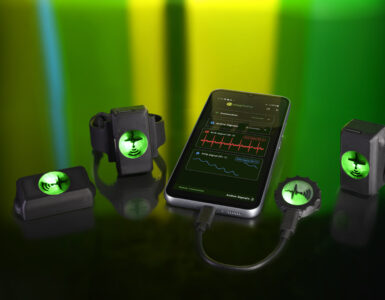
Fraunhofer maphera® is the one-for-all solution for the location-independent acquisition of high-quality multimodal physiological data. This portable, wireless sensor platform seamlessly integrates biomedical sensors, including ready-to-use wearables or custom sensors. The highly synchronized sensor network allows exceptional subject mobility while ensuring superior physiological signal quality and data consistency.

Smart Chair & Textile-integrated Motion Sensing
Capacitive motion sensors are integrated into the seating surface and backrest of vehicle seats, chairs, or into lying surfaces combine inconspicuous sensor technology for capturing body movements with robust algorithms for mapping and interpreting movement. The low height of the sensors (approx. 0.5 mm) allows natural comfort, while their narrow design ensures that seating and lying surfaces remain breathable. The Smart Chair technology demonstrator was developed by Daimler Research and features Fraunhofer IIS capacitive sensor technology.


Cinema Lab
The cinema on our premises is not only well-equipped to showcase innovations from Fraunhofer IIS’ Audio and Media Technologies division, but it can also be configured for biosignal measurements. It essentially works like a large exposure cabin, allowing multiple test subjects to experience immersive study situtations simultaneously and consistently. 15 seats can be outfitted with BIOPACs to monitor ECG, respiration, oximetry, EEG, EMG, and skin temperature for detailed physiological monitoring. Cameras below the cinema screen are integrated for camera-based analysis.

Hardware Lab
Our hardware lab is the linchpin during the development, assembly, and testing of embedded systems. Its setup offers exceptional flexibility for fast prototyping, allowing us to efficiently iterate designs and test new concepts, significantly accelerating the development process.
The hardware laboratory is equipped with
- Soldering Workstations, soldering oven, and rework station (ERSA PL550A)
- Pick & place machine (fully automatic SMD machine) for prototypes and small series production
- 3D printer: SLA (Formlabs 3) and FFF/FDM (Prusa Mk3s und Mk3s+)
- Impedance analyzers (MFIA, DropSens) & Potentiostats (Biologic VSP-300)
- Keithley 4200A-SCS parameter analyzer (current-voltage (I-V), capacitance-voltage (C-V) and pulse characteristics)
- Microscopes (Vision Manis Elite-Cam HD, Vision EvoCam II)
Clinical Settings: Infrastructure at the Center for Sensor Technology and Digital Medicine
The Center for Sensor Technology and Digital Medicine, established by Fraunhofer IIS in collaboration with Universitätsklinikum Erlangen and Friedrich-Alexander-Universität Erlangen-Nürnberg (FAU), offers a unique infrastructure and reference systems for developing, integrating, and validating innovative health technologies. Located at the premises of Universitätsklinikum Erlangen, our specially equipped laboratories facilitate independent testing and implementation of patient-specific therapies, digital health applications, medical diagnostics with wearables, and robotic nursing systems in a clinical setting.

Motion Lab
The gait analysis lab is equipped with a state-of-the-art 3D-Motion Capture System, 12 infrared cameras, and 2 force plates. This setup allows us to support patient-centered therapies and validate new sensor technologies by objectively analyzing movement patterns.

Cardiology Lab
The cardiology lab offers long-term and observational monitoring of a wide range cardiovascular and electrophysiological parameters with different activity profiles, including assessments for patients under minimal exertion in a patient bed and during treadmill or ergometer exercises. In addition to in-lab evaluations, we provide mobile monitoring solutions using wearables, which also include validation to ensure accuracy and reliability.

Physiology Lab
Our lab specializes in the objective recognition, interpretation, and processing of human affects. We offer advanced networked sensor solutions, emotion-adaptive technologies, and perception-based user interfaces tailored to meet specific customer needs. The multimodal approach can incorporate
various modalities, including infrared, eye tracking,
ECG, respiratory analysis, and EMG, to thoroughly capture psycho-physiological data.

Medical Data Lab
In our Medical Data Lab, we develop solutions and technologies for digital patient and study management as well as solutions for interoperable interfaces and data models using international standards (FHIR®, SnomedCT, LOINC, …). Our customizable study management system DPM.research streamlines data management and documentation in clinical studies, aligned with international standards and data protection regulations.
Deep Learning Infrastructure
In addition to data acquisition, our capabilities encompass the entire workflow of intelligent data analysis, including AI-based analysis and development. This process involves prototyping, integrating AI into applications, and creating high-quality datasets using bootstrapping techniques.
To support this comprehensive workflow, we have established a robust on-premise infrastructure that enables the rapid development and deployment of AI solutions tailored to our customers’ applications. This infrastructure facilitates efficient design iteration, concept testing, and the delivery of exceptional AI products.
Our deep learning infrastructure includes:
- Local High Performance 35 Node Cluster, 72x NVidia P100 GPU, 16x NVidia P40 GPU, 2.8 TB RAM, 4x H100 GPUs, 1.5TB and AMD EPYC 9654 CPUs
- Several single-GPU Nvidia RTX 3090/4090 and multi-GPUA5000/A8000 workstations.
- RRZE-hosted IIS-owned 3x4xH100 SXM5 Nodes with general access to the NHR compute cluster.
As a basis for our AI-based algorithms, we have created a multimodal database for the detection of cognitive overload: ADABase (Autonomous Driving Cognitive Load Assessment Database).
Image Copyright: Fraunhofer IIS / Bianca Möller & Paul Pulkert



 Markus Jechow
 Dr. rer. nat. Christian Münzenmayer
Add comment