

 Grit Nickel
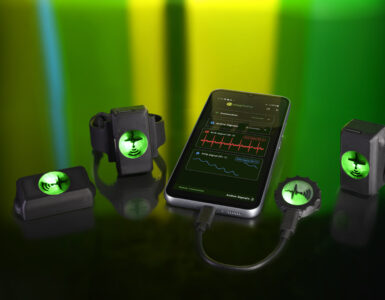
The Fraunhofer innovation system is built on knowledge transfer and turning ideas into solutions. One technology currently on its journey from research to market is maphera® , our wireless modular sensor network. The team behind maphera® is currently participating in AHEAD, Fraunhofer’s technology transfer program.
Let’s take a behind-the-scenes look at what it takes to bring technology to market and what customers can anticipate when integrating Fraunhofer technology into their products. We spoke with Stephan Göb, Senior Engineer, and Dr. Tobias Sebastian Zech, Senior Scientist in the Medical Sensor Systems group.
Like many Fraunhofer technologies, maphera® is not an off-the-shelf product; it’s designed to be integrated into a customer’s specific use case, which helps with fast prototyping. Please tell us more about how that works and what makes maphera® unique.
Stephan: At Fraunhofer, we prioritize understanding what the customer wants and how we can integrate that into our developments. We offer our customers the opportunity to influence and shape the development of maphera® from the very beginning. This is a unique process and a decisive advantage over commercial wearables, where you‘re limited to specific products and can‘t add your own features
Tobias: Ultimately, maphera® helps customers speed up prototyping in medical technology. Our technology features generic interfaces that can be tailored to meet specific requirements. Plus, we bring years of experience in developing wearables, recording biosignals, and signal processing pipelines, all of which benefit customers as they develop their own use cases.
maphera® enables data collection without restricting subjects, allowing them to move freely. Plus, our system offers direct access to all raw data.
You just brought up commercial wearables. What are the benefits of your approach compared to other biosignal acquisition system?
Tobias: Basically, there are two approaches. One is to use one of the big players in biosignal processing, which tend to be bulky and inflexible. Another downside is that subjects lack the mobility needed for certain studies or prototyping when using cable-integrated sensors. The other option is to go with commercial wearables, but that limits you to their specifications. If you want to use multiple wearables or different products for multimodal biosignal acquisition, synchronizing those signals becomes a challenge. That’s a core issue: How do we make sure the data quality meets the requirements for each customer’s specific use case, while also providing flexibility and mobility?
Stephan: So, in a nutshell, we provide a mobile solution that captures signals with laboratory-quality precision. It enables studies and data collection without restricting subjects, allowing them to move freely. Plus, maphera® offers direct access to all raw data.
Can you walk me through the process: I’m interested in this system and reach out to you. What happens next?
Stephan: We start off with a conversation to understand your requirements and what systems you already have in place. Then, our team discusses how we can integrate everything and what adjustments we might need to make. After that, we come together again to decide where the development of the maphera® system will go next. And throughout the development phase, we’ll keep in regular contact with you.
Tobias: Ultimately, our customers end up with a maphera® system tailored to their needs and the biosignals they want to track, and they can use it pretty much right out of the box. If it’s a more generic use case, we can even provide a basic system at the beginning, allowing customers to conduct initial measurements and see if their ideas are feasible.
Stephan: Plus, customers benefit greatly from our years of study experience. We can identify potential issues early on or suggest improvements to refine the study process or data acquisition for better results.

If I’m correct, you guys just stepped out of the research bubble and are now focusing on the customer’s perspective on maphera® in the AHEAD program. Please tell us more and what comes next for you.
Stephan: The great thing about AHEAD is that it provides a comprehensive view of the entire project – not just from the developmental angle we’re used to, but also exploring its potential directions and assessing its market value. Currently, we’re conducting interviews with potential customers across various fields to understand their needs and how we can meet them.
Tobias: We also need to identify what’s necessary to turn maphera® into a product that can be licensed by customers. At this point, we’re not aiming for a spin-off; instead, our focus is on developing maphera® into a licensed product that can ultimately be shaped into a final product tailored to the customer. Right now, our primary goal is to improve usability and to determine minimum requirements for different customers. Each market segment values different features when it comes to usability, so we’re working on identifying those features to make maphera® more attractive for the largest and most relevant market segment for us.
Talking about technology transfer and to wrap things up, how would you describe the ‘Fraunhofer spirit’ in your own words?
Stephan: What makes Fraunhofer special are the incredibly bright minds and talented engineers who don’t just operate within their own bubble; they maintain a broad perspective and look beyond the obvious. With maphera®, we’re doing just that: We’re expanding our vision and exploring all the possibilities of what it could be used for – and then incorporating these insights into the system.
Tobias: For me, Fraunhofer has always been the bridge between universities or basic research institutions and industry. The Fraunhofer spirit is about diving into these topics and translating them into something that truly adds value to society. It’s not just about profit; it’s also about providing infrastructure, systems, and technologies that everyone can benefit from. I see maphera® as a great starting point for this – similar to the MP3 license, which was ultimately made available to everyone. Many other technologies have emerged from that, and we hope to achieve something similar with maphera®: to bypass the gatekeeping in medical technology regarding wearable development and offer a lightweight, easy-to-use system that enables small companies, startups, and medium-sized enterprises to develop new medical products.
Image copyright (cover image): Fraunhofer IIS / Paul Pulkert


 Markus Jechow


Add comment