
How can sensors and non-invasive procedures make healthcare more efficient? And how can we integrate novel medical technologies, for example the non-invasive measurement of intracranial pressure, into clinical routine...

How can sensors and non-invasive procedures make healthcare more efficient? And how can we integrate novel medical technologies, for example the non-invasive measurement of intracranial pressure, into clinical routine...

Tomorrow’s healthcare is increasingly data-driven. Collecting robust and reliable medical data is essential for making informed decisions at every step of the medical care process. Artificial intelligence (AI) plays a...

Who would have thought that my sweaty palms could ever be relevant for a study … I am Anna, a working student at Fraunhofer IIS, and that’s what I’m thinking to myself as I’m sitting wired up on...

When acquiring data for affective computing, we aim for a multimodal mix of data as it allows for a more comprehensive and accurate understanding of human emotions and behaviors. By collecting multimodal data, such as...
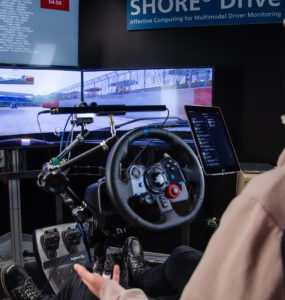
Not only does the future of mobility look autonomous: the present already is. Features like adaptive cruise control and lane centering support drivers and reduce required interactions with the vehicle, thereby...

Affective computing, also known as Emotion AI, is an area of artificial intelligence that focuses on developing systems and technologies capable of recognizing, interpreting, and responding to human emotions (read more...

© Fraunhofer IIS · 2026
 Matthias Struck
 Grit Nickel
 Anna Chiwona