

Transporting today’s increasingly long and heavy wind turbine blades is becoming more complex. Every step – from loading to ship and road transport to final installation – introduces mechanical loads that can cause damage if not fully understood. To make this process safer and more efficient, Fraunhofer IWES is developing advanced load-case analysis methods aimed at detecting risks early and feeding insights directly back into blade and handling-equipment design.
Why blade transport needs better monitoring
Wind turbine blades can reach lengths of 100 meters or more. During transport, they experience a combination of static and dynamic loads: shocks from uneven roads, torsional deformation during handling, pressure points from clamping systems, and cyclic stresses over long journeys. Existing transport processes often rely on experience and best practices – but without detailed measurements, potentially damaging load events can go unnoticed.
As rotor blades grow longer, they become more flexible and more sensitive to how clamping forces, contact pressures, and torsional loads are applied.
IWES approach: load-case analysis in scaled and full-scale testing
The first step in developing monitoring solutions is a thorough understanding of potential failure mechanisms and maximum allowable load values. To determine the blade behavior during transportation, Fraunhofer IWES performs both small-scale tests on critical blade subcomponents – especially the shear web segments – as well as full-scale test campaigns. Selected full-scale tests can also be carried out at the customer’s premises using Fraunhofer IWES test setups and measurement systems. The alternative would be to carry out the relevant tests after the certification test if the rotor blade is already at Fraunhofer IWES.
After developing test scenarios that simulate realistic transport damages, tailored test specimens are created. Optical measurements with cameras, digital image correlation (DIC), as well as acoustic emission (AE) or thermography are utilized to identify and locate initial crack formation.
These controlled tests help researchers understand likely damage mechanisms before moving to full-scale investigations.

© Fraunhofer IWES / Nils Englisch
Fraunhofer IWES investigates:
- blade deflection in multiple directions while clamped in a transportation frame
- the effects of badly positioned clamps or over-clamping
- pressure distribution across contact zones
- handling limits and pressure concentration areas
- alternative contact materials (e.g., different rubber Shore hardness)
- blade angle and displacement through draw-wire sensors and 3D scanning

© Fraunhofer IWES
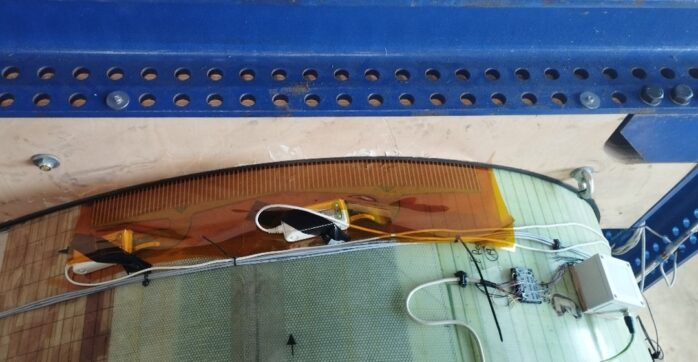
Thin foil sensors (0.25 mm) are used to map pressure distribution in clamping zones.
The sensors provide:
- high spatial resolution (9×9 mm measurement cells)
- peak pressure measurement up to 3 MPa
- time-resolved data up to 100 Hz
- 2D/3D heatmap video output
This allows researchers to identify localized stress peaks that might cause internal damage. This information is crucial for optimizing clamp geometry, padding materials, and operational handling.

© Fraunhofer IWES
© Fraunhofer IWES / Heiko Rosemann

© Fraunhofer IWES / Heiko Rosemann
To capture a complete load picture, Fraunhofer IWES supplements pressure measurements with:
- bolt force monitoring via strain gauges
- acoustic emission sensors for crack initiation detection
- 3D scanning to measure pre-torsion of the blade inside transport frames
Implications for industry: safer, smarter transport
The insights gained from Fraunhofer IWES’ load-case analysis play a crucial role in enhancing transport safety and efficiency. They help reduce the risk of costly damage during transport, guide improved handling rules and clamp positioning, support the development of next-generation transport frames, inform blade designers about real-world stress scenarios, and enable future live handling assistance through sensor-based guidance systems. As blades continue to grow in size, such data-driven evaluations will become essential for ensuring safe and economical logistics planning.
Outlook: toward integrated transport monitoring
Looking ahead, the vision is to establish a comprehensive monitoring system that covers the entire journey of the blades, from factory to installation. Future systems could include real-time sensing of bolt forces, torsion, and accelerations, as well as automated warnings when handling instructions are exceeded. Additionally, integrated operator-assist systems utilizing live visual feedback could be implemented. With these advanced tools, manufacturers, transport providers, and installation teams could significantly reduce uncertainty and improve reliability throughout the process.