

The shipping industry faces the challenge of reducing its emissions. One effective option is the use of wind propulsion systems such as Flettner rotors: They harness the wind to supplement conventional ship propulsion and can thus reduce fuel consumption. Over the past three and a half years, the FlettnerFLEET research project has further developed this technology for widespread use on various types of ships – including validation and digitalization measures.
The project results show that Flettner rotors can reduce ships’ fuel consumption, thereby making an immediately available contribution to lowering emissions in shipping. As part of the project, the partners specifically designed ships for operation with Flettner rotors, improved the rotor technology, and tested and validated assistance systems for maritime use.
To conclude the project, the partners presented key findings regarding Flettner rotors from the three focus areas – shipbuilding, technology, and data – in June 2026, in Leer. The project partners presented their findings and innovations in keynote presentations and at a small trade fair.

Focus on shipbuilding
The use of Flettner rotors has a significant impact on ship design. For this reason, extensive aerodynamic and hydrodynamic studies were conducted at the Hamburg Ship Model Basin (HSVA). The insights gained were directly incorporated into various designs.
For example, HB Hunte Engineering designed an ammonia tanker with a cargo capacity of 90,000 m³, which can save approximately 15 percent in fuel consumption by utilizing four Flettner rotors and corresponding design optimizations. A second ship design focused on a multipurpose vessel 149 meters long with two deck cranes, utilizing three Flettner rotors. Both ships were analyzed in HAZIDs under the direction of Bureau Veritas with regard to the integration of the rotors into the ship’s design.
Technological aspects
SCHOTTEL reported on the approach taken in the design of Flettner rotors and how this influences the final rotor design itself. Innovative bearing concepts and structural optimizations not only reduce capital costs but also lower operating costs.
Today’s Flettner rotors are usually made of fiber-reinforced composites. IBK-Fibertec investigated various materials and manufacturing processes for Flettner rotors in terms of weight, production costs, and manufacturing effort, and determined that glass-fiber-reinforced plastic (GFRP), combined with specialized manufacturing methods, is currently the best option. Possible alternatives, particularly for very large rotors, could involve the use of aluminum sandwich structures.
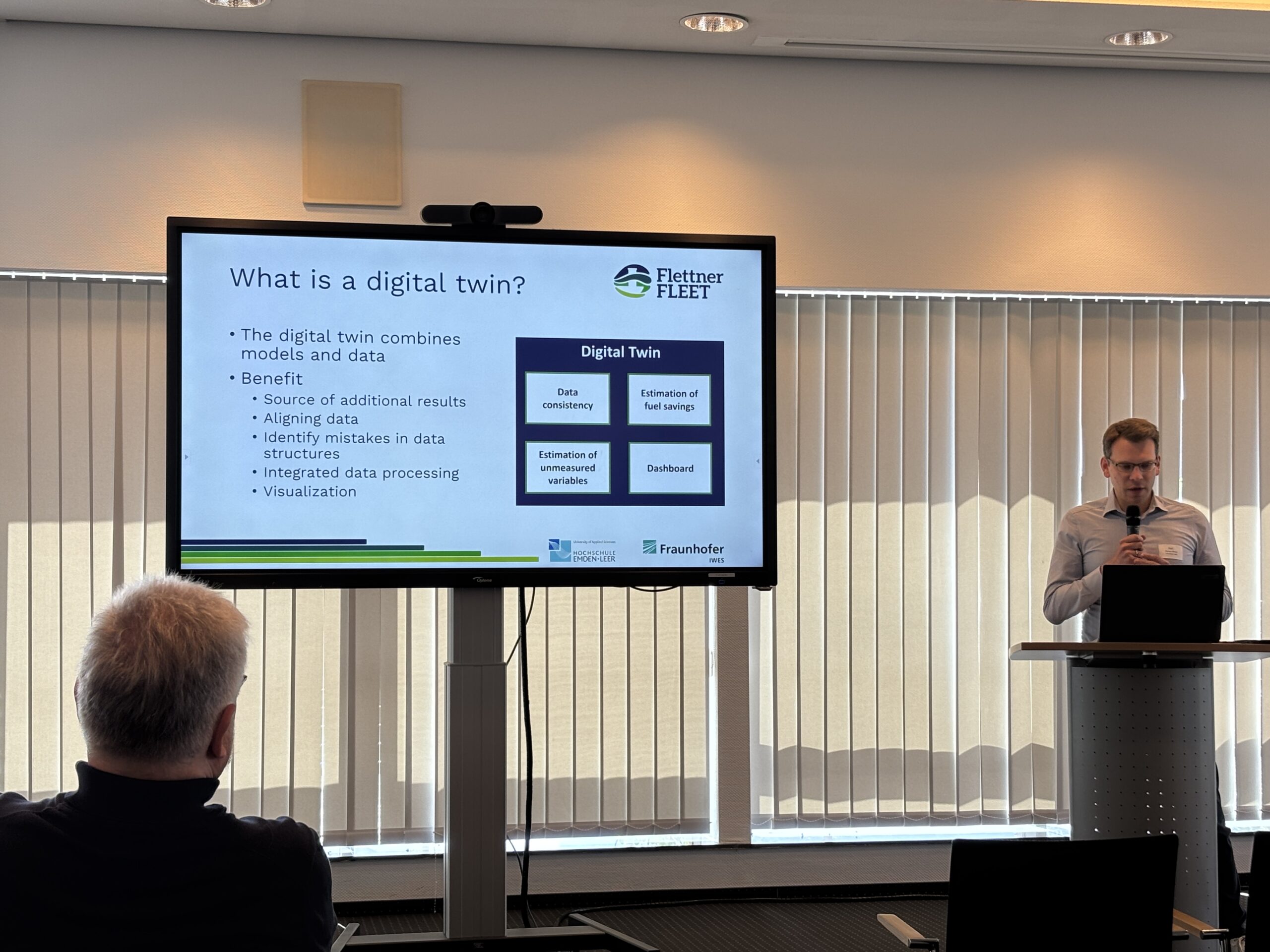
Scientists at Fraunhofer IWES designed a digital twin for use on ships. The digital twin is based on an elastic multi-body model of the Flettner rotor, which is simulated in real time. This approach enables an in-depth understanding of the operating state, allowing, for example, the analysis of rotor thrust and the mechanical loads on the rotor. Based on the model data, the operating state can be optimized in terms of fuel savings or mechanical loads, among other factors. A test phase of the digital twin took place as part of a measurement campaign on an ECO FLETTNER EF18 rotor aboard the MV Annika Braren, operated by the RÖRD BRAREN SHIPPING COMPANY. Measurement data collected on board can be compared with the values generated by the model to identify potential operational deviations early on and implement operational optimizations.
Another assistance system was further developed and optimized by the University of Applied Sciences Emden/Leer. With the help of simulations, the maneuvering behavior of ships equipped with Flettner rotors can be better predicted to increase safety during local voyages and in emergency situations.
Data as a key basis for decision-making
The University of Applied Sciences Emden/Leer presented its development work, which enables fully automated wind tunnel testing to predict the performance of complex Flettner rotor configurations. Thanks to this automation, it is now possible to reduce test times in the university’s Maritime Technical Center wind tunnel from several days to just a few hours.
A comparison with data from Flettner rotors on board was made possible by the metrological characterization of a Flettner rotor by Fraunhofer IWES aboard the MV Annika Braren. As part of a measurement campaign lasting several months, the project team equipped the ECO FLETTNER EF18 rotor with extensive measurement technology to record its operating condition based on parameters such as rotor thrust, vibrations, and deformations. In addition, two lidar systems were installed on the ship to map the wind field in front of and above the ship and to validate the use of a so-called nacelle lidar for deployment on ships. The measurements taken as part of the validation campaign provided the project team with a much clearer understanding of how the Flettner rotor behaves in interaction with the ship under various weather and cargo conditions. A statistical analysis was used to quantitatively measure the rotor-related fuel savings as a function of various operating conditions. Furthermore, an analysis of the deformation behavior provides a better understanding of the dynamic loads on the rotor.
Flettner rotors as a building block for more climate-friendly shipping
With regard to achieving IMO and EU climate targets in shipping, MARIKO GmbH demonstrated through its calculations that Flettner rotors can support compliance with the emission requirements under FuelEU Maritime and thus help avoid or reduce penalties.
The FlettnerFLEET project demonstrates that Flettner rotors are a forward-looking and practical solution for achieving the climate targets of the IMO and FuelEU Maritime. The technology can be combined with green fuels, is retrofit-ready for the existing fleet, and makes an important contribution to the decarbonization of shipping.

Presentations from the closing event:
The presentations are available in German for download on the MARIKO website: https://www.mariko-leer.de/wp-content/uploads/2026/06/FlettnerFLEET_Abschlussveranstaltung-2.zip
About the FlettnerFLEET Project:
FlettnerFLEET is a research project aimed at developing and testing Flettner rotors as wind propulsion systems for shipping. The project was initiated by the company Eco Flettner, which built a strong consortium consisting of MARIKO GmbH (project lead), SCHOTTEL GmbH, Fraunhofer IWES, HB Hunte Engineering GmbH, Bureau Veritas, Hamburgische Schiffbau-Versuchsanstalt (HSVA) GmbH, IBK-Fibertec GmbH, and the University of Applied Sciences Emden/Leer. The project is funded by the Federal Ministry for Economic Affairs and Energy pursuant to a resolution of the German Bundestag.
Project website: FlettnerFleet
Project description: FlettnerFLEET
Further information:
Ensuring safe wind turbine blade transport through comprehensive load testing
In the lee of wind farms: spotlight on wake effects of wind turbines
Site investigation in complex geological terrain