

As part of the energy transition, the structure of electricity generation is undergoing a fundamental change. With the decline of conventional power plants, the rotating mass in the grid is decreasing. As a result, the stabilizing properties that were previously provided primarily by synchronous machines – such as those used in conventional coal- or gas-fired power plants – are increasingly lacking. Consequently, grid-forming controls for power-electronics-coupled generation facilities – such as wind turbines or battery storage systems – are gaining in importance. In January 2026, transmission system operators in Germany began market-based procurement of inertia, also referred to as instantaneous reserve. In this market, the provision of inertia is remunerated based on the level of availability. A prerequisite for participation in this market is compliance with the requirements described in the VDE FNN Guideline “Technical requirements for grid-forming capabilities including provision of inertia”. As part of a measurement campaign at Fraunhofer IWES, these requirements were tested for the first time on a multi-MW battery energy storage system (BESS).

How do grid-forming generation units differ from conventional systems?
Grid-forming generation units and storage systems differ from conventional systems primarily in that they actively set voltage, frequency, and phase angle, thereby enabling them to generate or support a stable grid on their own. Conventionally, grid-following systems, on the other hand, adapt to an existing grid and feed their power into this predefined electrical environment. An electrical grid consisting predominantly of grid-following systems can lead to critical stability problems.
In terms of control behavior, grid-forming units act more like voltage sources, whereas conventional grid-following converters operate more like current sources. As a result, grid-forming systems can provide important system services even in weak grids, during island operation, or during black start. In addition, they can provide inertia in the event of grid frequency deviations by very quickly supplying power from intermediate circuits, storage systems, or coupled primary energy sources. Whether these characteristics are met must be demonstrated in practice.
What kind of tests were conducted, and what makes the completed measurement campaign special?
The recently completed measurement campaign with the BESS sets new standards both technologically and methodologically. For the first time worldwide, all tests required for certification in accordance with the VDE FNN Guideline “Technical requirements for grid-forming capabilities including provision of inertia, Version 2.1” were conducted in this power range using a grid emulator without passive loads. A BESS with a capacity of over 2 MW was used as the test specimen. The campaign shows that the requirements of the VDE FNN Guideline can be technically and reliably replicated in a Power Hardware-in-the-Loop (PHIL) test setup of this power class without scaling. This also demonstrates the feasibility of this approach for future qualification and validation procedures, in which real power hardware is coupled with a virtual simulation environment. This creates a solid foundation for the further development of grid-forming systems and their integration into future energy systems.
What test infrastructure was used to conduct the test?
As part of the measurement campaign, the Mobile Grid grid emulator shown in Figure 2 was used to simulate the electrical grid. It is connected between the test specimen and the grid connection point to isolate and protect the public grid.
All system components are housed in standardized shipping containers, making the grid emulator mobile and allowing it to be deployed flexibly at other locations. Mobile Grid has a modular design and consists of two units with a mirrored layout, each with a capacity of 14 MVA. These can either be operated separately or coupled to form a 28 MVA system with a short-circuit capacity of 80 MVA. One of the two units was used during the completed measurement campaign.

In the context of the PHIL test setup, Mobile Grid serves as the interface between hardware and software. The grid emulator is capable of emulating various grid configurations as well as typical grid faults, including symmetric and asymmetric under- and overvoltage events, frequency changes, and phase jumps. This allows for systematic verification of the system’s compliance with requirements. The tests are executed using an internal Fraunhofer IWES automation system that enables the scalable generation and execution of test scenarios. As part of the completed campaign, more than 1,000 tests were created and carried out within a few weeks on this basis, with approximately 150 tests serving certification purposes. In addition to the conventional fault scenarios mentioned above, a so-called islanding test was also conducted for the first time at Fraunhofer IWES.
What is an islanding test?
An islanding test determines whether a power generation plant or a storage system can switch to stable island operation after being disconnected from the public grid and can safely maintain that state. In particular, the test verifies whether the system can maintain a stable operating point at constant voltage and frequency and also ensure stable behavior in the event of disturbances.
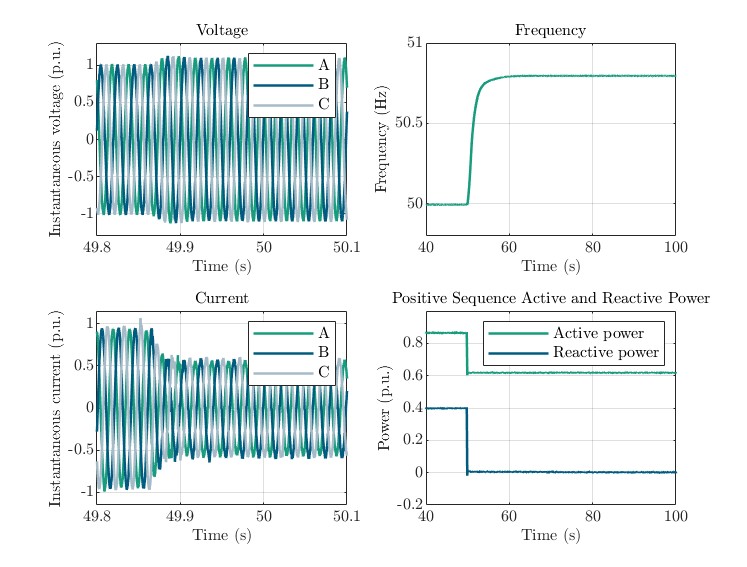
A key aspect of the test is the transition from regular grid-connected operation to islanded mode. According to the procedure described in the VDE FNN Guideline, a coupling switch to the external grid is opened while the system is in grid-connected operation. This causes the system to switch to an simulated island network, represented by a resistive or constant load. Figure 3 illustrates a test conducted as part of the measurement campaign. At t = 49.85 s, the coupling switch to the emulated public grid is opened, and the test specimen transitions to island operation with a constant load. As can be seen, the BESS reacts virtually instantaneously by reducing power output to meet the power demand of the simulated island and reaches a stable voltage and frequency after a few seconds. This test verifies whether the test specimen can react immediately to a sudden change in the setpoint.
Battery energy storage systems must be able to switch spontaneously from charging to discharging mode while handling a 100 % change in power. The island network test thus provides important insights into whether a system can be operated safely and stably even when disconnected from the grid or in off-grid operating conditions.
What’s next?
For the first time, the measurement campaign at Fraunhofer IWES on a multi-MW scale that the requirements for grid-forming battery energy storage systems, as specified in the VDE FNN Guideline, can be reliably verified using a realistic PHIL test setup. Following the successful completion of all tests planned for the BESS on the test bench, an accredited certification body is currently evaluating the measurement results, while the VDE Testing and Certification Institute is conducting the simulation-based verification and the certification process. This could enable one of the first offers to participate in the instantaneous reserve market to be submitted to the transmission system operators.
Next, the findings will be incorporated into peer review committees and the work of the FNN, particularly regarding the testing in the multi-MW range and the evaluation of selected tests. At the same time, the test concepts for grid-forming control strategies in the PRAKTISCH and ENGEL research projects will be applied to and tested on wind turbines, with a particular focus on potential interactions between converter control and mechanical components, as well as the control of converters in high-voltage direct-current transmission systems in offshore wind farms. This will create an important foundation for putting grid-forming systems and the provision of inertia into practice as key components for a stable, renewable energy system.
You may also be interested in:
Weather risk analysis for offshore wind farm installations
Floating Lidar System: Validation as Stage-3
A new approach to data management: NEXUS meets complex requirements