


Fraunhofer FOKUS and Deutsche Telekom conduct a friendly-user field test on energy consumption and savings potential in streaming as part of the Green Streaming project.

Series on, feet up, popcorn ready – the perfect evening. But while we relax and enjoy our favorite content, the electricity meter is running at high speed. Its evening is far from over. The reason: our devices are among the main energy consumers within the streaming value chain. Our Green Streaming whitepaper shows that they account for 70–80 percent of the total energy demand of streaming – and therefore also offer the highest savings potential.
But how much exactly?
After initial measurements in our Fraunhofer FOKUS TV-Lab, we wanted to gain a more comprehensive view of the possible savings under everyday conditions. That’s why, together with our project partner Deutsche Telekom and the Green Streaming Measurement Framework we developed, we moved directly into the living rooms of our test users. To collect data, participants were equipped with a small device: an electricity meter in the form of a smart plug, which we specially configured to measure the power consumption of end devices during streaming.
In this way, we were not only able to gather valuable data for the further development of our Green Streaming solutions such as FAMIUM GreenView and our Green Streaming chatbot FAMIUM Wattlify, but also gain a better understanding of what sustainable streaming can look like in everyday life.
Experimental Setup
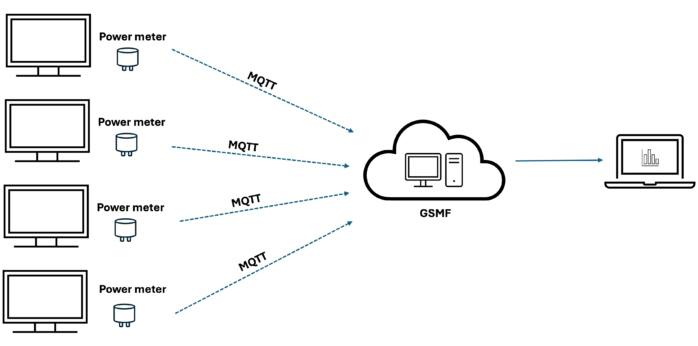
For the friendly-user field test, we placed the measuring devices between the end device and the wall socket, connecting them to the participant’s home Wi-Fi.
Preconfigured by our team, the smart energy meters were able to report the power consumption of each device every second via MQTT to our Green Streaming Measurement Framework (GSMF). Within the GSMF, we can create predefined “jobs” that specify the video content to be played, device-specific settings, playback conditions, and details of the measuring device itself.
An Energy Metric Worker then tracks the power usage and related metrics, feeding them into our FAMIUM Streaming Analytics solution. As part of this field test, we integrated the smart energy meters as new measuring devices within the GSMF. Once the data was collected, it could be explored and analyzed using rich dashboards and analytic tools.
For the participants, the process was refreshingly simple: after setup, all they had to do was switch on the TV and start watching.
To ensure the results were comparable, all participants received the same task: over a period of two weeks, they were asked to watch the same daily news program (Tagesschau) on 2 to 4 different days. The program was accessed via the media library of the public broadcaster (Das Erste) or a similar app on their TV. At least once, the viewing session had to be carried out with the television’s energy-saving mode (Eco Mode) activated.
After completing their measurements, participants were invited to fill out companying questionnaires. We collected details about the devices in use, measurement device IDs, the availability and discoverability of the Eco Mode on their TV, network settings, as well as subjective impressions and experiences while watching with and without Eco Mode.
Results & Analysis
Measured Devices
Among the participants’ devices, there were notable differences in both size and display technology. The majority of the measured devices were LCD TVs, followed by OLED and QLED models. Screen sizes ranged widely—from 40-inch sets up to large 75-inch displays. The figure below provides a detailed breakdown.

Streaming Type Comparison
We evaluated the energy consumption of both video-on-demand (VOD) streams and live streams of the same content. The results showed that the transmission type had very little to almost no impact on the device’s overall energy consumption.

Analysis of Measurement Data
Across all display technologies, enabling Eco Mode consistently reduced energy usage—by an average of around 37%.

A direct comparison between LCD/LED, OLED, and QLED devices is only partially meaningful, since the screen sizes of the tested models varied considerably, making straightforward analysis more complex. In general, we observed substantial variations even within the same display category, meaning broad generalizations are difficult to support. That said, newer technologies such as OLED and QLED tended to show higher savings potential compared to traditional LCD/LED devices. Actual consumption, however, depends not only on display size but also on the streamed content and device settings. Depending on these factors, power usage ranged from very efficient playback to relatively high consumption. To strengthen these insights, we plan to expand the sample size in future field tests and examine this in more detail.
Impact of Display Size
We also analyzed energy consumption by display size, grouping TVs into two categories: 50 inches or smaller and larger than 50 inches. The findings were clear—larger screens consume significantly more energy. TVs over 50 inches averaged 117.4 W, while smaller screens averaged just 55.9 W—a difference of roughly 52.4%. This underlines display size as a strong predictor of energy consumption and suggests that optimizing Eco Mode features for larger TVs could unlock even greater efficiency gains.


Survey Insights
As the measurement data already indicated, activating Eco Mode is an effective way to reduce energy consumption. The questionnaires revealed that most viewers would use Eco Mode if they knew it would save energy. At the same time, the majority admitted they were unaware of their TV’s current settings—or how to adjust them for more energy-efficient streaming. In fact, Eco Mode was disabled by default on nearly all participant devices.
This finding aligns with a study by ZDF (full study here), which showed that only a small share of viewers knew about Eco Mode on their TVs and even fewer actually used it. Yet, interest in such an energy-saving feature remains high.
One key barrier today is the lack of transparency: devices currently expose very limited / no interfaces (APIs) for accessing device settings or energy consumption data. This leaves both users and developers without the means to identify or leverage energy-efficient configurations effectively.
Green Streaming is tackling this challenge by developing innovative solutions like FAMIUM Wattlify that provide deeper insights into individual usage patterns, highlight concrete optimization opportunities, and support both viewers and providers in making streaming more sustainable.
Looking Ahead
Our recent developments in Green Streaming directly address this need: FAMIUM Wattlify, an intelligent chatbot designed to make streaming more transparent and sustainable.
FAMIUM Wattlify has two core goals:
- Accurately predicting power consumption of specific end devices.
- Estimating savings potential when enabling features such as Eco Mode.

Since even tech-savvy users often struggle to navigate their TV’s extensive menus, we trained the underlying large language model on device manuals. This allows Wattlify to provide device-specific instructions on where and how to adjust the right settings for energy-efficient streaming. Acting as a digital assistant, Wattlify bridges the gap between technical possibilities and practical application.
The result: viewers gain transparency into their energy consumption and can stream more consciously and sustainably. What makes Wattlify unique is that it leverages not only detailed lab data from our previous measurements. Now it also incorporates real-world consumption data from our field study. This enables highly accurate modeling of both device characteristics and user behavior patterns.
But that’s just an early result. Our vision is to look beyond end devices and consider the entire streaming value chain – from TVs and set-top boxes, through CDNs, all the way back to encoding. Only a holistic perspective can reveal the full energy footprint of streaming.
We are now working on expanding Wattlify into a powerful and reliable tool for TV and streaming providers. This will enable companies to calculate the CO₂ footprint of their streaming workflows and services and provide comprehensive data for their emissions and sustainability reports to fulfill the requirements of e.g. the Corporate Sustainability Reporting Directive (CSRD).