About the workshop
Toward open standards for shared virtual worlds
Immersive virtual world technologies are evolving into persistent, shared spaces that increasingly blur the boundaries between physical and digital life. They hold transformative potential across industry, education, healthcare, entertainment, commerce, and scientific research.
At the same time, current systems remain fragmented across closed hardware and software ecosystems. This workshop addresses interoperability, asset portability, platform lock-in, and the need for design and ethical frameworks that safeguard privacy, fairness, transparency, and human agency.
Program
Program w. presentation abstracts & slides
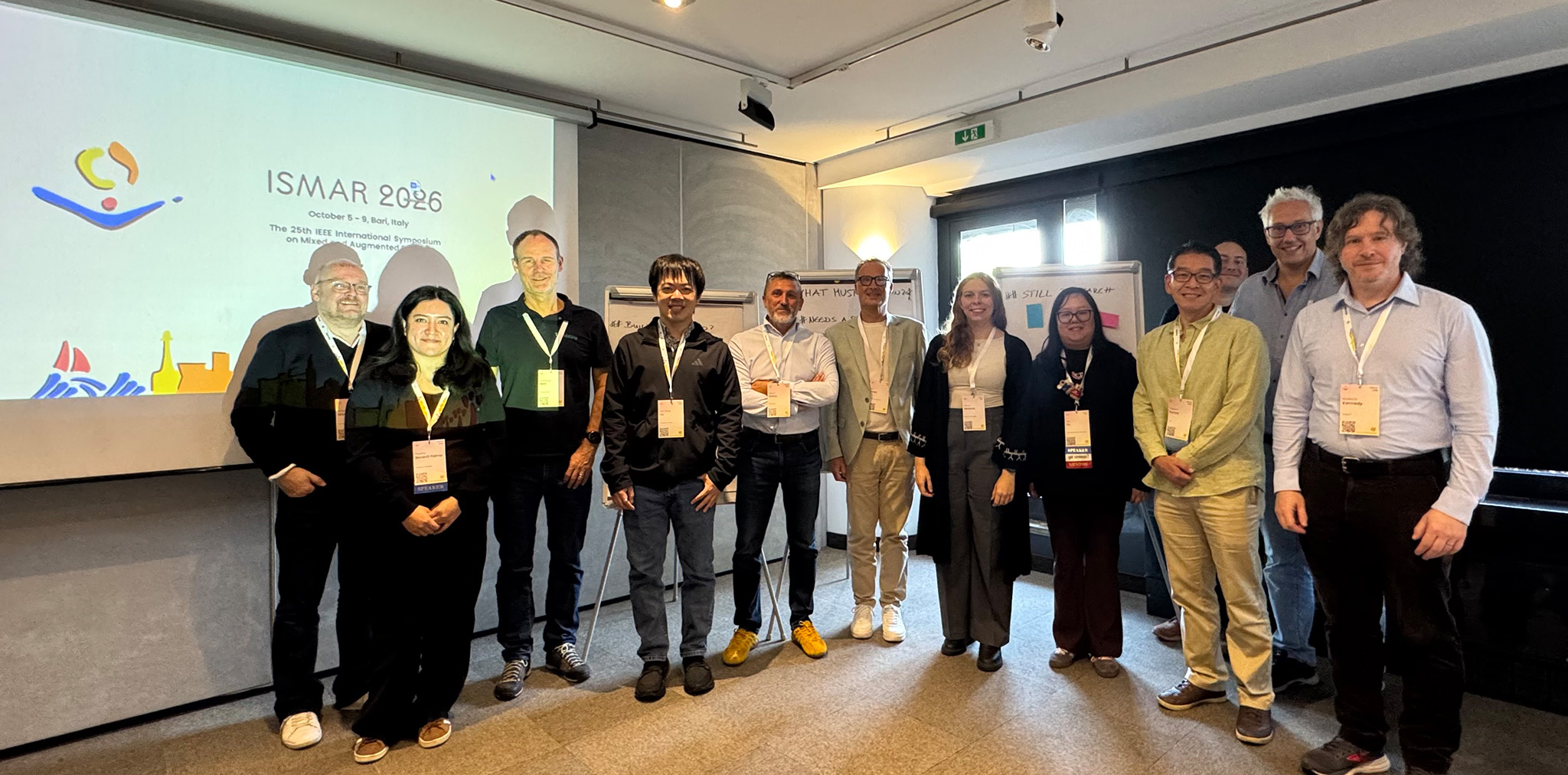
Full-day workshop — October 6, 2026
Room: Cigno.
| Time | Program |
|---|---|
| 09:00–09:45 | Session 1: Setting the Stage, Standardisation and the XR Landscape Welcome & introduction · Opening impulse · History and Governance of Terminology |
| 09:45–10:30 | Coffee Break |
| 10:30–12:00 | Session 2: Open and Trustworthy Worlds Open spatial worlds · Learning worlds · Trust, privacy & user agency · Group discussion |
| 12:00–14:00 | Lunch Break |
| 14:00–15:30 | Session 3: Building the Interoperable Ecosystem Spatial networking · Interoperability for complex systems · Spatial anchoring · Group discussion, expectations for Virtual Worlds Partnership & workshop wrap-up |
| 15:30–16:15 | Coffee Break |
| 16:15–17:45 | Organizers Meeting (internal) |
The Global Race for Virtual Worlds Standards Actors, Gaps and Coordination
Abstract
XR and Virtual Worlds build on a large and highly distributed ecosystem of existing standards, specifications and standardisation activities. The talk highlights the global standardisation system, strategic regional approaches, and key gaps and structural challenges identified by the ViWISSO study. It concludes with approaches to improve transparency, coordination and adoption, including the VDC’s evolving XR and Virtual Worlds Standards Landscape.
XR is XR: Revisiting the Evolution and Governance of XR-Related Terminology
Abstract
The term XR is widely used as an umbrella expression encompassing Virtual Reality (VR), Augmented Reality (AR), and Mixed Reality (MR). However, there is still no clear consensus regarding either its origin or its meaning. Although XR is often interpreted as an abbreviation of Extended Reality, multiple interpretations exist regarding its origin, interpretation, and subsequent adoption. This paper revisits the historical development and governance of XR-related terminology by organizing the origins, reinterpretations, and adoption of major terms, including VR, AR, MR, XR, and the Metaverse. By distinguishing between the coinage of terms and the drivers of their adoption, we argue that XR, as an umbrella term, functions not as an abbreviation of Extended Reality but as a neutral symbolic label encompassing multiple reality-related concepts. Furthermore, we discuss how terminology evolves through interactions among academia, industry, and standards development organizations, and argue that terminology governance requires balancing conceptual innovation with conceptual clarity according to the roles of different stakeholders, thereby providing a foundation for semantic interoperability in emerging domains such as XR and the Metaverse.
The Web of Worlds – Towards a Referential Architecture for Open Spatial Worlds
Abstract
This paper formalises the Web of Worlds (WoW) initiative as a Web‑native architectural framework for cross‑world XR experiences that enables 3D spatial content to break free from existing technological silos, building on the Metaverse Standards Forum's (MSF) 3D Web Interoperability work. The presented work derives requirements from the current research initiatives on interoperability frameworks for XR and the requirements set out within the EU Virtual Worlds partnership and the MSF, by showing how existing web standards and technologies might be able to deliver open spatial worlds and interactive experiences across decentralised platforms. The position paper presents a referential 3D web architecture specifying an Open Spatial Worlds (OSW) API, a lightweight glue layer that exposes linked spatial assets and linked spatial experiences over existing Web and 3D formats (X3D, glTF, USD, OGC APIs). The paper further introduces the “Digital You” manifest and 3D Web user agent as a user‑centred runtime for portable identity, consent and accessibility, and define an interoperable AI endpoint model based on MCP for spatial perception and agentic assistance. An initial implementation in industrial digital‑twin pilots demonstrates already a basic cross‑engine interoperability and runtime performance, providing the XWorlds community with a concrete, standards‑aligned basis for Web 4.0 virtual worlds. We discuss limitations and open research questions for large‑scale deployment.
A Web of Learning Worlds: Open Infrastructure for Persistent 3D Education
Abstract
Multi-user educational virtual worlds can support collaborative learning, shared exploration, and learner-created spaces, but they are still often delivered as isolated applications, temporary course spaces, or closed platform services. Current practice across web-based platforms, native XR systems, and immersive-learning communities shows sustained educational demand, while three barriers persist: costly platform operation, costly content production, and weak interoperability. These barriers limit institutional cooperation and make cross-institutional learning paths difficult to sustain. This position paper argues that persistent 3D learning environments should instead be conceived as open, web-based, federated infrastructure: a Web of Learning Worlds. Worlds should be addressable, linkable, accessible across device classes, and capable of combining virtual, dataenhanced, georeferenced, and hybrid representations. Web ofWorlds can provide the horizontal layer for addressing, linking, composition, and federation. glTF with the emerging KHR_interactivity extension can support portable scene content and local behavior, while an educational profile can express learning intent, institutional integration, accessibility, safeguarding, and privacy requirements. This paper outlines design principles, a platform concept, an implementation roadmap, and a research agenda for sustainable, privacy-preserving, interoperable learning-world infrastructure.
Building Trustworthy xWorlds: Privacy, Ethics, and User Agency in AI-Driven Virtual Environments
Abstract
AI-driven virtual worlds (xWorlds) are fundamentally transforming how individuals interact, collaborate, learn, and create within digital environments. Although immersive and interoperable virtual environments have advanced considerably, this paper argues that the long-term development of xWorlds is dependent on trust among users, communities, organisations, and intelligent systems, and that trust should be established as a foundational design principle rather than treated as an emergent property. Drawing on Bursell’s definition of trust as a maintained state, this position paper identifies privacy, ethics, and user agency as three mutually reinforcing pillars of trustworthy xWorlds. These pillars constitute a layered framework in which trust is achieved through verifiable technical and governance mechanisms rather than assumptions of good behavior. Key research challenges are identified, including privacy-preserving XR infrastructures, adaptive consent for inferred data, explainable AI for immersive environments, and governance of autonomous virtual agents. The proposed framework offers a foundation for designing trustworthy xWorlds that align technological innovation with human values and societal expectations.
The Teleport Spatial Network Protocol: Design and Implementation
Abstract
Teleport is an open, application-level network protocol and software development kit for client–server virtual, augmented and mixed reality (collectively, XR). By analogy to the World Wide Web, a Teleport client acts as a “Metaverse Browser” onto virtual worlds operated by servers supporting the protocol: the application lives on the server, while each client renders a partial, real-time view of an authoritative simulation, so that immersive applications can be used instantly, without download or installation. This paper describes the purpose and history of Teleport and its reference client and server implementations, and presents the design principles that shape the protocol: openness, responsibility, trust, extensibility, and minimalism. We argue that an open network of virtual worlds can grow organically if the protocol surface is kept narrow, if the responsibilities of client and server are clearly demarcated, and if the server places no trust in the client beyond what the protocol itself warrants.
XR Interoperability as a Prerequisite for Model-Based Systems Engineering in Human Spaceflight
Abstract
Large-scale space engineering programs are frequently dependent on effective coordination between geographically dispersed stakeholders from a wide range of fields and industries. Various Model-Based Systems Engineering (MBSE) approaches have been proposed to help facilitate such coordination, however, they have only seen limited success due to the fragmented requirements inherent in large space projects. This position paper argues that eXtended Reality (XR) could serve as a more accessible, unifying medium for early-stage MBSE methods due to its intuitive visualization and real-time collaboration capabilities. As demonstrated by the OpenXR framework, achieving interoperability between distinct XR solutions is possible under the right conditions. Nevertheless, important gaps remain, such as network protocols for multiplayer synchronization, spatial computing APIs, and cross-platform avatar systems. By examining the strengths and limitations of OpenXR, this paper identifies key barriers hampering XR-mediated MBSE and proposes a research agenda tailored to advancing its integration within human spaceflight systems engineering.
Towards Interoperable Spatial Anchoring for Augmented Reality
Abstract
This paper reviews both the existing approaches to persistent spatial anchoring in augmented reality (AR) and the interoperability challenges they raise. It examines the main technologies used to attach virtual content to real indoor and outdoor environments, then discusses how these approaches are implemented across current AR ecosystems and the current limitations for cross-platform reuse. The paper also analyzes existing standardization efforts, including ones from Khronos, W3C, ETSI, MPEG and Open AR Cloud. It shows that, despite the availability of multiple anchoring technologies and ongoing standardization work, interoperability remains limited by heterogeneous anchoring models, proprietary representations, and vendor-specific cloud services. It further argues that the adoption of common standards remains gradual, in a context where AR technologies are still evolving rapidly, the market remains relatively immature, and device manufacturers and platform providers have not yet fully converged on shared and open approaches.
Call for Papers
Submit a position paper or case study
We invite 2–4 page submissions, excluding references, following the IEEE Computer Society VGTC conference format.
Friction Points
Identify where current virtual worlds introduce rigid standards, interoperability barriers, and asset portability challenges.
Platform Innovation
Explore novel approaches promoting federated architectures as an alternative to centralized platform models.
Sovereignty and Ethics
Develop frameworks that prioritize user autonomy and data privacy over centralized corporate control and profit.
Workshop goals
Participants will share experience and research findings, engage in collaborative discussion, and contribute to a Strategic Research Agenda for designing virtual worlds around interoperability and shared standards.
- Discuss open-standard reference frameworks for interoperable virtual worlds.
- Surface shared challenges across platforms, tools, workflows, and ecosystems.
- Develop design heuristics for open, interoperable, and ethical virtual worlds.
Submission
Format: 2–4 pages excluding references, IEEE Computer Society VGTC format.
Types: Position papers and case studies.
Publication: Workshop materials are planned for inclusion in the conference proceedings.
Submit via EasyChairImportant dates
Mark your calendar
People
Organizers
Program Committee
Contact
Questions?
Please contact the workshop organizers at leif.oppermann@fit.fraunhofer.de or tommy.nilsson@fit.fraunhofer.de.